I thought Mirage Mir would be a slow channel for communicating & exploring fav topics of memory, language and learning, outside of the enshittified social media.
A kind of supplement that would give me energy for so-called real life. A sanity engine, even?
But as is the way of the world, events took (are taking) such a surprising turn that the sanity engine has real use and impact.
In the last few months the importance of knowledge systems has exploded. They are turning into business value, as they say, for both individuals and whole companies.
And all that R&D in memory systems is becoming useful for making a real living.
When I catch myself worrying that the consultant is crowding out the dreamer and the enjoyable, playful part of my praxis is being neglected, I realise that this cannot even happen.
Because progress is so fast, almost vertical, the only useful way to think about what is possible seems to be imagination & the imaginary: what-if scenarios, thought experiments, design fictions.
So I cannot afford to lose the dreamer. He is the only one who can still see ahead. That is why my praxis depends on moving between the two modes, fictional and real. Ludic vs. utilitarian.
This can be seen in the very nature of the newsletter as opposed to the story.
Bouncing between fictional and real

The story
The story level of Mirage Mir helps me figure out (imagine) what a future (or ideal) memory system & knowledge praxis could look like. The story functions as:
- a thought experiment,
- a design fiction artefact,
- a what-if scenario.
Consider the following in-world elements and what questions they enable:
Praxis of Princess Ateh: learning to build a lifelong archive, a second brain. Libraries store and process these archives. Asking: what if building a second brain were part of everyone’s education, like literacy?
Glass Bead Game: ideas and memory objects are the game pieces, and the game decides offices and political status. Asking: what if the quality of someone’s knowledge practice decided roles, careers and leadership?
Lexicon Cosri: a national knowledge base; contributing to it is an honour & cultural practice. Asking: what if personal notes grew into a shared knowledge commons?
Glyphs and syzygies: the best dream hunters compose knowledge into “a glyph containing all content”; syzygies are “myths written like project notes.” Asking: what distils notes the way notes distil sources?
The story is also a longing for a fairy tale, an attractive story, where imaginary characters, scenes and events are bound together along a timeline. A sequence, a chain, a journey you experience in linear order, from start to finish.
The letter
The newsletter level helps me with practical exploration: learning, discovering, describing what is happening around me.
Also, it demands effort: the text has to be readable, have pace, a beginning and an end, and be as comprehensible as possible.
What also distinguishes it from the story is its finishedness, its publication as an irreversible act of completion.
Oh, sending the letter, absolute as a finished picture that you frame and hang on the wall!
Compare that with a digital service or application that you keep developing, where the word final does not and should not exist.
The dynamic between pleasure and the practical

The dynamic between the letters and the story/paracosm forces – or rather motivates – me to enrich one with the other.
Pleasure affords & brings professional insight vs. professional insight affords & enhances pleasure.
Allure, attraction and excitement of imagination fuelling practical research and real-life impact, and vice versa.
That interplay between the real and the invented is what keeps me motivated to do the important work.
An example of how the dynamic works

In my day job, I work across CX, service design, strategy, and transformation.
Professional insight regarding UX & future interfaces + memory systems or knowledge & learning topics conjures up the image of the playing board of the Glass Bead Game.
In Mirage Mir, the Glass Bead Game is a tradition and the heart of Cusaria's political & cultural system: at once a contest of thought and memory + a public spectacle + the mechanism by which the country chooses its ruler.
I research and think about a new-generation interface for the enormous amount of data and context that a knowledge worker handles and it is this research that inspires and helps me imagine:
- what such a nationwide playing board might look like,
- and how players could arrange and shape their experiences, attitudes and reactions to other players on it,
- but also what stories, what consequences this game may have.
In order to see that playing board even better, or how such a game can be played, I notice more details of this world, and I devote myself with greater appetite to the real topic of interfaces that the AI era might bring.
The beauty: while modelling a story or a scene (while worldplaying), I can grasp or solve some real-world problem, see it from another angle.
Sometimes the invented shifts, inspires and enriches the real (how and what I experience, what I work on and how I grasp and solve it), and at other times the real – what I experience and what I work on – clarifies and improves the invented:
- Development of the invented world: the more I experience and learn, the better a paracosm I have, and
- Learning and growth: the better a paracosm I have, the more fun, the more intoxicating and the easier it is to learn and move forward: I have the motivation to expend mental energy, even on so-called work or material I have to learn and understand.
Hence, the sanity engine.
Actually, a certain English philologist and teacher (and a writer of fiction on the side) used a similar approach.
The philologist's work-life strategy

Languages
Long before he taught old languages, the boy was already inventing his own. What started as a teenage game grew into the Elvish tongues: Quenya (modelled on Finnish, Latin and Greek) and Sindarin (modelled on Welsh), with Khuzdul, Adûnaic, Westron and the Black Speech surviving only as fragments.
The invented languages led him into the real ones, and the real ones fed back into the invented. To design Elvish well enough, he had to devote himself to historical languages; and his private inventions shed light on how real languages evolve.
One thing drove the other, that mutual dynamic.
And it worked, because imaginary languages and imaginary literatures function like so many experiments in the evolution of grammar, vocabulary and narrative tradition.
Construct a language for fun, the teacher & philologist wrote, and “you will have had, only more consciously and deliberately, and so more keenly, the same creative experience as that of those many unnamed geniuses who have invented the skilful bits of machinery in our traditional languages.”
The rules of his made-up languages work like the atoms of a memory system: basic assumptions, the notes in the non-linear library of a second brain.
Myths & legends
And besides, he created a corpus of mythology of a fictional world, something like what you'd get if someone had compiled the Edda, the Kalevala and Genesis for a single invented civilisation.
It is known as The Silmarillion.
Formally, it is a collection of texts of varying genres and varying “depth of time”, which together form the cosmology and history of the invented world.
It has no main hero, no unified storyline, no modern narrator. It is a fictional textual tradition: it pretends to be the result of translations and redactions of older sources within the world.
It gave his linguistic taste a world to live in: a paracosm, an imaginary world.
A world given depth by a reference layer of myths that any story can merely allude to.
Stories
And oh boy & girl, did the stories arrive.
The most linear, the longest to produce and the easiest to use for connection/communication with other people.
His first published novel, The Hobbit, had nothing to do with the legendarium of The Silmarillion, yet our dear philologist soon realised that he had forged a kind of Rosetta Stone that would allow him to translate some part of his private mythology into a publicly “edible” art.
A narrative artefact, emphasising characters in the grip of adventure.
The Hobbit had children in mind, and seventeen years later he followed it up with The Lord of the Rings, a darker, adult novel, published in three volumes.
All of the levels constitute an elaborate form of the game of inventing a country. Thus his private passion for worldplay shaped his professional vocation, and vice versa.
The method in the story is the method of the story

The philologist wrote the stories so that the languages would have a world in which they could exist, and not the other way round.
I cannot compare myself to this humble teacher, whom family and close friends called Ronald, but I love the principle and use it in my own Xennial way.
Mirage Mir is set in a universe where people use invented worlds to create, store and recall knowledge. An imaginary world is their second memory.
And the same holds outside the book. The story, and the world it takes place in, is my second memory.
The characters do not know that they are memory.
But they practise the same method by which I build and use the story. Over a lifetime, I encode experiences and motives into pieces of plot and into characters, and in their pockets I hide little doors to the library & memory.
Consider going through various real-life situations like projects, expeditions, books or even jobs, just to discover and define connections between phases, scenes and milestones of an imaginary world.
Behold, the consistent return over a long period of time to a specific scenario!
Yes, this is my kind of fun: inside the story, people keep their memories in imagined worlds. Outside the story, so do I.
So the method in the story is the method of the story.
Does it make sense?
Talking about practice and autonomy

The scenes, characters and ideas of a paracosm, and the story built from them, function both as a second memory and as an interface.
They also enabled me and gave me the courage for the topic I wrote about in the previous letter: talking on a stage as a different type of pressure to help me develop or speed up thinking about memory systems and knowledge work in the age of AI.
 Peter
The pressure comes from the audience being present: structure and order matter, and the words must be chosen carefully, because other people have to be able to interpret them.
Discomfort is the only way out of inhibition + it is an honour to feel the pain of growth stretching my old bones, as DJ Haram said.
In my mind it looks like pushing myself off a cliff. Into water, but still...
After the August 26 talk, Part Two took place on October 8, diving deeper (pun intended) and going more practical.
I argued that a second brain, and mainly the practice around building & using it, can become a safeguard against cognitive surrender: against handing over to artificial intelligence not only tasks, but also thinking and decision-making.
Strategy, futurism and culture work is so much vaster than an output from a machine.
In everyday work you either keep your independent thinking, or you hand it over piece by piece, and the second-brain platform & practice provides the place where thinking stays yours.
But I am no Luddite: the good question is not either/or, but how to balance the tension between humans and AI, as two kinds of value or two speeds.
So the skill that helps = consciously choosing, for each task, how much autonomy to hand to AI.
I presented and described four basic levels of Human-AI collaboration, from full authorship to full delegation:
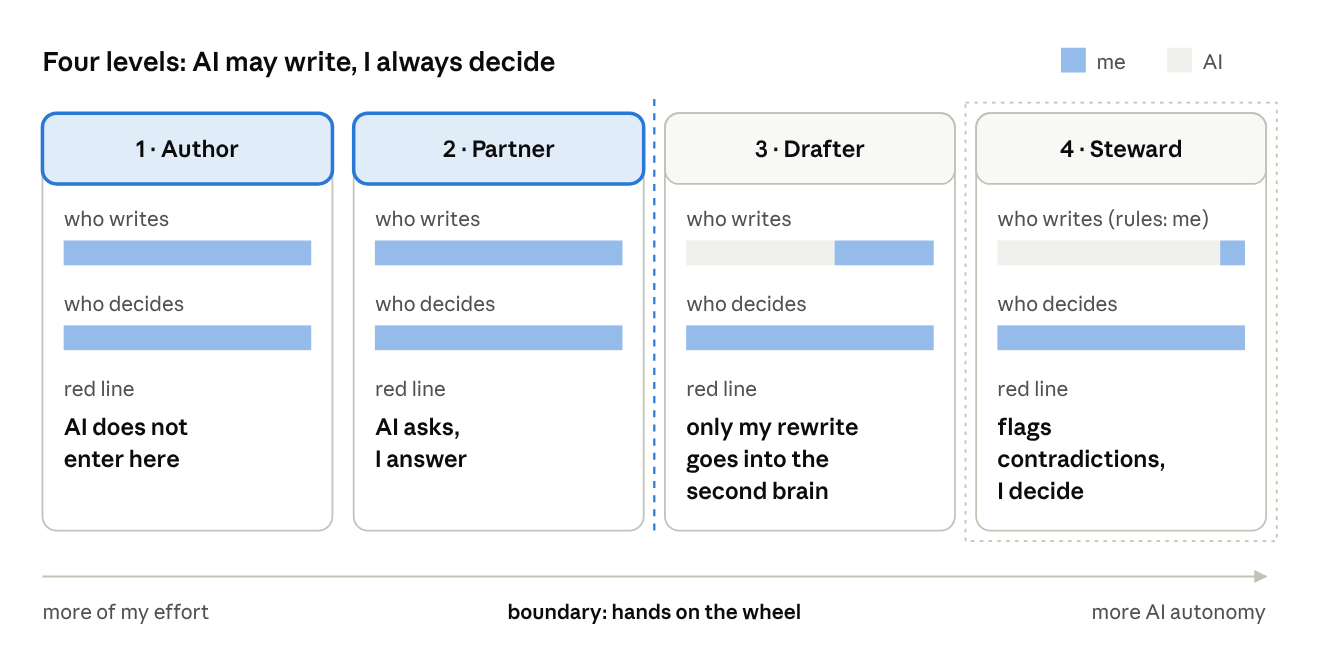
Or explained via a metaphor of cooking, the line is where you hand over the ladle:
- Author: you cook alone, from the recipe to the tasting.
- Partner: a helper shops, chops and reminds you of the recipe, but you do the cooking.
- Drafter: a ready-made base, the basics are done; you season it and serve it under your own name.
- Steward: a hired cook cooks for you; you plan the menu and do the tasting.
A ready meal is fine for an ordinary lunch, but if you want to learn to cook, you have to cook yourself.
Mind you, the four levels are not a ladder to climb. Nobody should aim to live on level four. They are more like gears: you shift down when you are learning something new or forming an opinion you will have to defend, and you shift up when the work is maintenance: the kind of work that was never thinking in the first place.
Consider this gap: when I asked who had written something in their own words, just for themselves, in the last week, five hands went up. When I asked who had talked to an AI, every hand.
Aliveness over efficiency

But so there is no mistake: I am not some workflow design or knowledge management nerd.
Rather, I care about the outcome, about a certain lifestyle.
The process must be fun.
That is, first comes the playing, and only second the maintenance or excessive attention to the... bicycle.
Because it is similar: you probably also know people who spend more time tuning and updating components, yet somehow don't undertake real adventures on two wheels. Tuning the system rather than the ride itself.
It is something like the Agile Manifesto, where you have several pairs of values, such as:
Individuals and interactions over processes and tools
And the crucial sentence at the end of the manifesto binds them all: (...) while there is value in the items on the right, we value the items on the left more.
Similarly: while there is value in a good system & method, I value the fun more.
While there is value in efficiency, aliveness is more important.
Mira Melko, a protagonist within the Mirage Mir universe, claims that inner motivation stands above all the other problems of knowledge work.
In that scene, it is the spring of an alternative 2010, and Mira answers questions at her first job interview in Waldzell, but so many of this character's days are still unseen, unresolved and even undecided.
Niklas Luhmann wrote that the card index (Zettelkasten) should be a communication partner that surprises the author: without surprise, it is just an archive.
Mirage Mir thus functions as a second memory also because I do not yet know all of it.
In the autumn of 1992, eighteen years before that job interview, a younger Mira understands why she doesn't want to put the characters into the order of a story: “They are meant to be a memory system.” She is afraid that when she finishes writing the story, the world will disappear.
She explains her reasoning further:
“If one writes the story to the end, the story disappears. I have not the slightest desire to participate in such a waste. I prefer to keep the story with me forever, let nothing happen to it.”
I've come to consider this sentence rather important over the last few weeks, so I made it an eyebrow (the tiny line above the hero text) in the landing-page design facelift.
Go check the redesign and let me know whether you like it: https://www.miragemir.com/.
Risking
When writing this letter, I tell myself that I shouldn't write these letters so long and play with every sentence. But then I realise I don't know how to do it any other way yet, nor do I want to.
I enjoy it, and everything I discover thanks to that effort is worth it. All the more so when it happens in a safe space, separate from social media, powerpoints, reels and linkedins, where I can write about the topics I love.
Risking looking foolish, but without making concessions in form, topics or language.
Dedicating
This letter is dedicated to the progressive, egalitarian, empathetic fighter for truth & love before it was cool... or considered a weakness. I owe him a lot.
Have fun and take care,
Peter
. . .
The photos are all about my favourite & arguably most photogenic season. All taken by me, in recent years.
. . .
Related letters
 Peter
 Peter