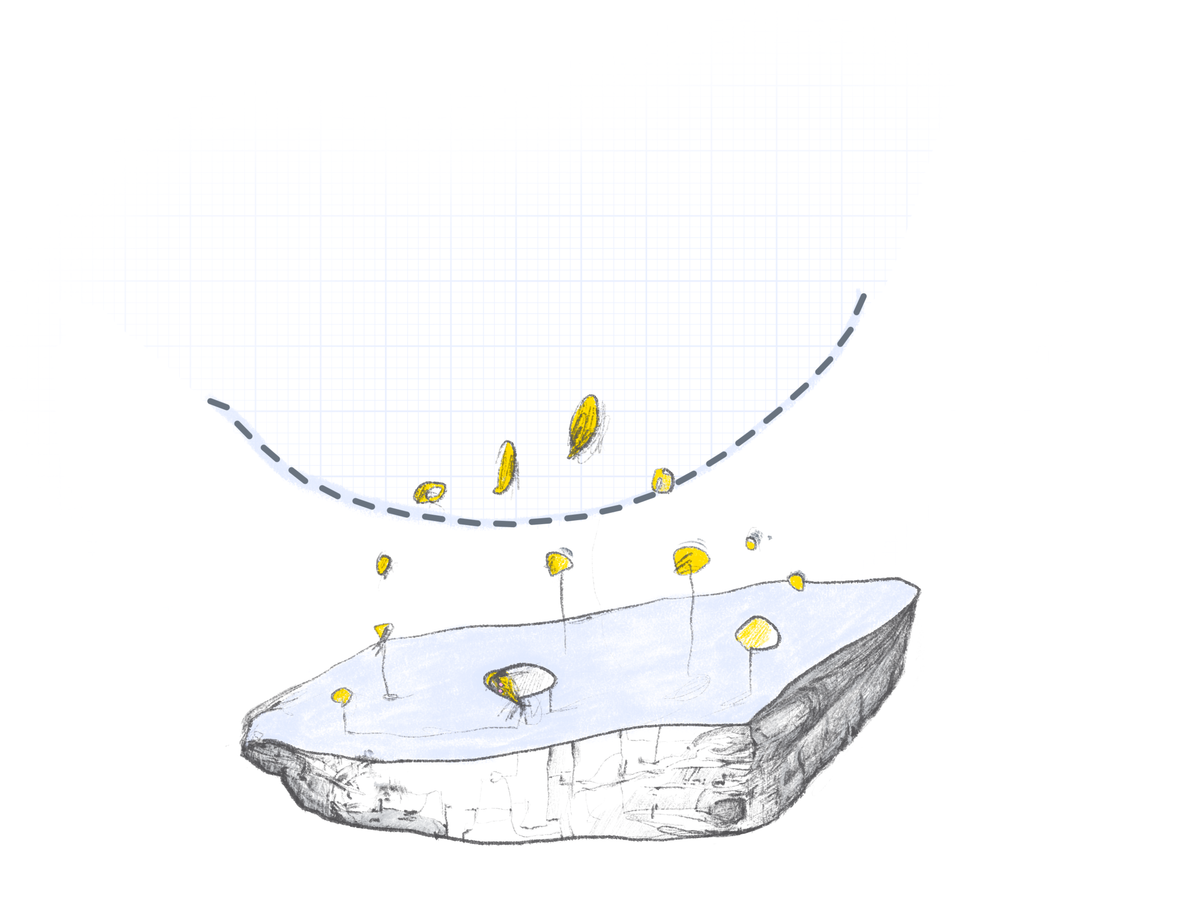
A scene: moving along the road as an obligation, contrasted with a pause as play
Tomáš Benka sometimes described movement along a path as the opposite of play, because the traveler has agency in the form of duty, a requirement to act: they must keep moving.
Thus, the road = an echo of accumulated events, a trace left by those who could no longer play, but needed to go somewhere.
In play, by contrast, you form a relationship with space by settling in, by paying attention to the location/self, because there is no need to go from somewhere to somewhere else:
- you are free to explore, following curiosity
- explore novelty and engage in generative creation: imagining what does not exist, bringing the new into being.
Visual artist Constant Nieuwenhuys draws upon similar idea in his New Babylon, an anti-capitalist city perceived and designed in 1959-74 as a future potentiality:
"While in a utilitarian society one strives by every means toward optimal orientation in space — efficiency and economy of time — in New Babylon, disorientation that enables adventure, play, and creative change is privileged."
. . .
A road is made by intention and repetition, not by play — the road is a sad reminder of the iron inevitability of life:
To deny the sequence of time, to deny the self, to deny the universe — all of that seems like a desperate endeavor; in reality it is a secret consolation.
Our fate is not terrifying because it is unreal. It is terrifying because it unfolds with iron inevitability.
Time is the substance I am made of.
Time is a river that sweeps me along, but the river is me.
Time is a tiger that tears me to pieces, but the tiger is me.
Time is a fire that consumes me, but the fire is me.
The world is (alas) real, and I am (alas) too.
— Jorge Luis Borges
Topics:
- agency, duty
- attention
- inevitability of life
- megastructures
Related:
 Peter
Peter
 Peter
Peter
 Peter
Peter