Experiencing landscape like the architecture of your apartment
Tomáš Benka used to say
I wish I could experience & remember a landscape the way I experience and remember a room — through thousands of repeated observations and moments of careful attention.
So he devised a psychogeographical game for experiencing the outside: superimposing the land with multiple scales.
Think of how you don’t really walk in a room, only travel a few main journeys in the scale of steps.
You reside in specific locations like an armchair in the corner or bed, or you open a fridge, approach a bed, sit behind a desk.
Often for years, a lifetime even: returning to the exact same spot, with the same posture.
A few square metres in the universe.
A forest as a network of rooms
In the open landscape you either use roads or you choose a direction or follow the relief depending on how much effort you’re willing to endure.
You walk on the scale of hundreds of meters, but more often kilometers.
But imagine a forest as a network of room shaped spaces. Terrain divided into smaller units the size of rooms, thousands of kitchen floors, lifetimes of routines.
Imagine a forest as a network of rooms, with their corners formed by trees, stones, or features of the terrain.
What if you could experience & remember a landscape the way you experience and remember a room — through thousands of repeated observations and moments of careful attention?
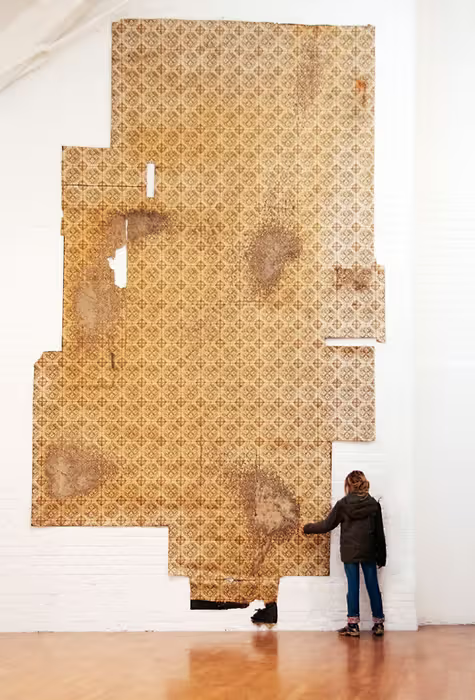
Oliver Beer's artwork "Oma's Kitchen Floor" might be used as a neat mnemonic device for Benka's game.
This is how Beer describes the piece:
“Oma was the name I called my grandmother. She put the lino down in the 1960’s and over four decades her feet gradually wore through the decorative pattern. Over the years marks appeared in front of the oven, the sink, the front door, where she turned around in front of the fridge, where she sat at her table shuffling her feet. Like a drawing made over forty years, these worn patches describe half a lifetime of movement.”
Related images and scenes:
- territories incomparably larger than the tiny objects spread within them
- a desire to play on every piece of huge landscape, the effect of intense awareness of micro-scale, to have segments of a route or territory lived-in, segment by segment, like a childhood home
- the strange feeling when visiting places outside of the routine, the effect of stepping off the road, out of the white hot glowing lines of the heatmap
- castle with many rooms — hundreds of rooms, corridors, halls, doors, and staircases: the Peony room at the beginning of Ann Leckie - Translation State
- spending childhood so that every day/week a “settlement” would be created, and with a few families you’d always inhabit a new space of a few (tens of) square meters — inevitably each location would gather experiences, stories, and/or rituals; micro-local names would emerge (parts of tree roots, grooves, small terrain waves)
- one birch here, one fir there, and in the back small alders or elms — experiencing this space like the architecture of an apartment or another frequently visited place, i.e.:
- here your child walked for the first time
- in these square meters (even decimeters) lie memories of your life (objects, furniture, equipment, the decoration of a home)
- here you spent person-days on a project.
- the consistent return over a long period of time to a specific scenario in worldplay = as evidenced by the naming of place and characters or the elaboration of a continuous narrative or other systematization.
- shrinking attention from macro scale down to the level of twigs — moving closer into the landscape
Related notes
 Peter
Peter