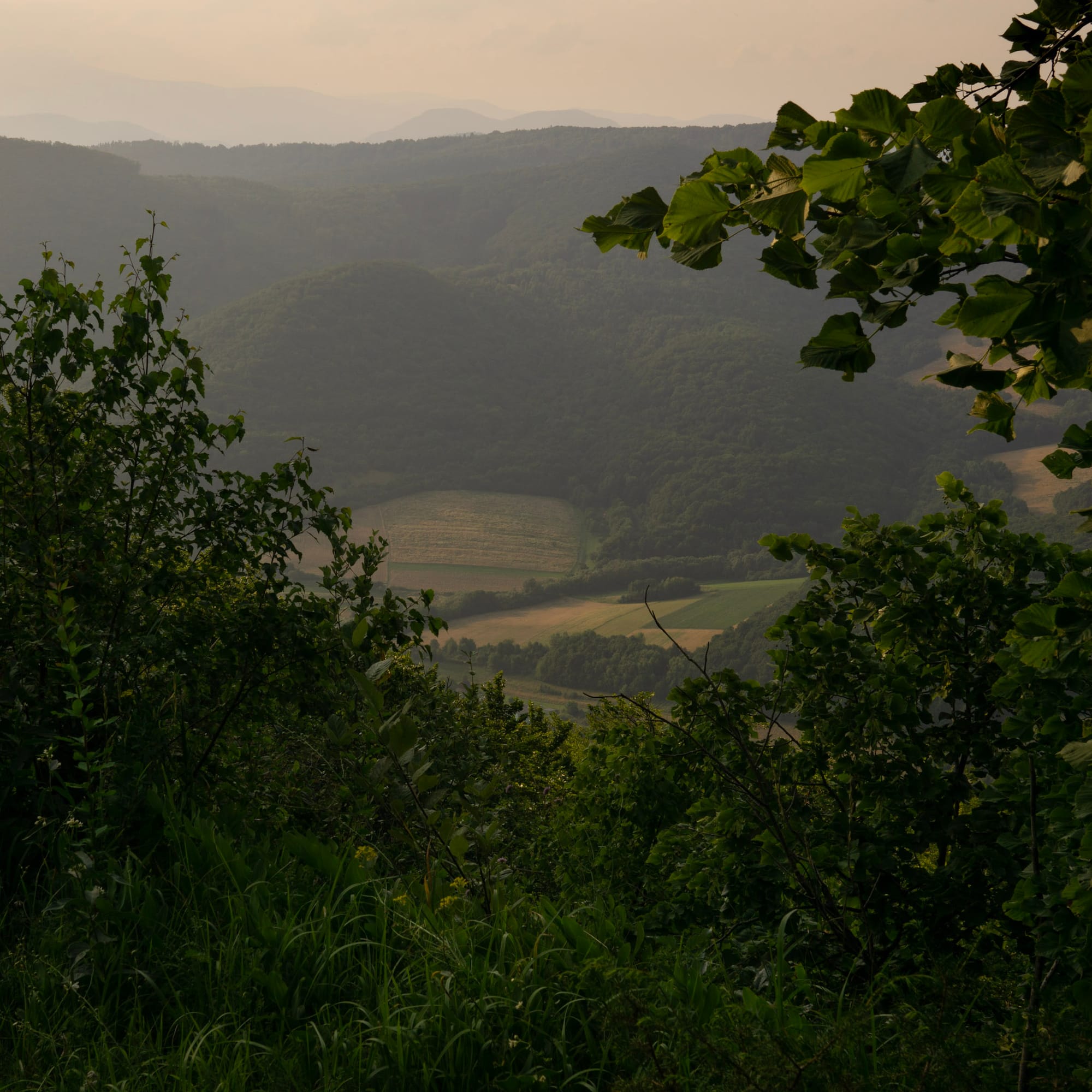
It is very to ultra hot when I put together this letter.
About how more and more people do not bother to write themselves and likely not even read.
An eternal problem, I guess, but with a little help from our AI friends, it has reached critical mass.
The situation: reading an article, a blog, a newsletter, and after a few lines I feel/know that I am paying attention to something "void of character, flair, passion and risk".
It's not because of X, but because of Y.
The lingering human connection that remained on the internet is now being diluted even further.
— Ossama Chaib, tropes.fyi
What does it mean & why is it happening? Am I sick of it, because writing becomes just another thing that feels like getting worse and more exhausting, in this era of intense technological progress?
Or maybe we will just get used to the fact that the texts we normally read are written, or at least edited, by artificial intelligence, flattened into the uncanny valley?
"People will just stop giving a shit - the way people always stop giving a shit about change and technological advances, which is to say gradually, and then all at once, without ever actually making an active decision."
— Ja Westenberg, In 5 years, nobody will give a damn about AI-detectors
Maybe indeed: I encounter AI-written articles with thousands of likes on Substack or Medium (linkedin not worth mentionin) and people (readers) seem to like or do not mind slop.
"Maybe the taste for organic hand rolled human only tokens will become a niche IQ taste similar to enjoying Japanese wood carvings or something."
Also: there are allegations that Pope Leo's first encyclical, Magnifica Humanitas, on safeguarding the human person in the time of artificial intelligence, is substantially written by AI.
Or maybe the obsession with tools is a displacement activity. It lets us avoid the harder judgment.
All in all, as if something were trying to make me sick of working with text and writing, and at the same time make me embrace it all the more warmly.
Tropes.md
So besides life, the universe and everything, I spent June 2026 tidying up my thoughts & feelings re: the topic of writing and language in the AI era.
An interesting trigger comes from my dear friend & reader Francis AKA minus f, when he sends me a link.
Without a comment, in the early hours of the night after Bloomsday.
A link leads to a markdown file that you can feed into your AI so it knows what to avoid in order not to sound like AI.
A single file containing all catalogued AI writing tropes.
Add it to your AI's system prompt to help it avoid these patterns (let's play cat and mouse!).
What is both fascinating and terrifying: that thanks to a semantic sequence like tropes.md you can hide, or at least suppress, the artificial origin of what is written = you give your language model instructions on how to draw attention as little as possible, so your text machine comes across as more human.
Is it cheating? Or just swapping Comic Sans for Times New Roman or Arial?
Cyberpunk story meets linguistic philosophy
But at the same time, thanks to prompts like tropes.md, you are looking at the deeper shapes of language.
If I had read this markdown file as a short story back when I was studying at university, I would have raved about it for years afterwards:
- How the function and construction of language reveal itself to you,
- the charm of attractive structures given away like a magician's trick,
- but presented as negation, as contempt,
- in the format of an incantation or a cheat sheet,
- that helps you fake a superhuman performance in the field of written text.
The proscribed
Many of the constructions the prompt warns against represent centuries of refinement in the building of texts, and it saddens me that we are consciously beginning to avoid them.
Such a file means that technology is forcing us to turn our backs on some of the best formal, tonal and syntactic inventions, because AI has appropriated and blunted them.
Made them void of character, flair, passion and risk.
You can work your way toward these inventions for years, distilling awesome words and sentence structures from books, films and lectures, training and trying and getting used to them.
Thanks to language models, many/more and more of them are becoming a sign of slop.
Thanks to AI, techniques that were until now perfectly usable are ending up on the list of the forbidden, of the proscribed.
The dash
If you learn how to write with stronger rhythm or cleaner structure, parts of your work will naturally resemble the same patterns language models absorbed during training.
Which creates this bizarre situation where people may start mistaking old writing techniques for evidence that you outsourced your article or story to a chatbot.
I may be subject to the same fate, though not for reasons as noble as the use of ancient language structures, but for merely a pitiful em dash (—).
My story is fairly full of these punctuation marks, because I longed to make paragraph-long sentences while at the same time not using colons or commas... long before ChatGPT embarrassed them long dashes lashes.
Now the em dash is the sign of the AI slop.
So do I have to gradually replace them in my text — the punctuation that lets long sentences breathe — or do I leave them where they are, because I honestly couldn't care less?
For now, I keep em dashes untouched in the story, but it might come to "felt cute, might delete later".
The shape
As questions of authorship and originality are becoming central to how written work is evaluated, researchers from the University of Maryland and Google DeepMind asked whether and how AI-generated stories can be distinguished from human ones.
They gave thousands of writing prompts to human authors and to five AI models, to generate more than sixty thousand stories, 5+K words each.
They looked at the underlying structure of each story the machines and humans generated and found out the shape of human writing is visibly different from the texts generated by AI.
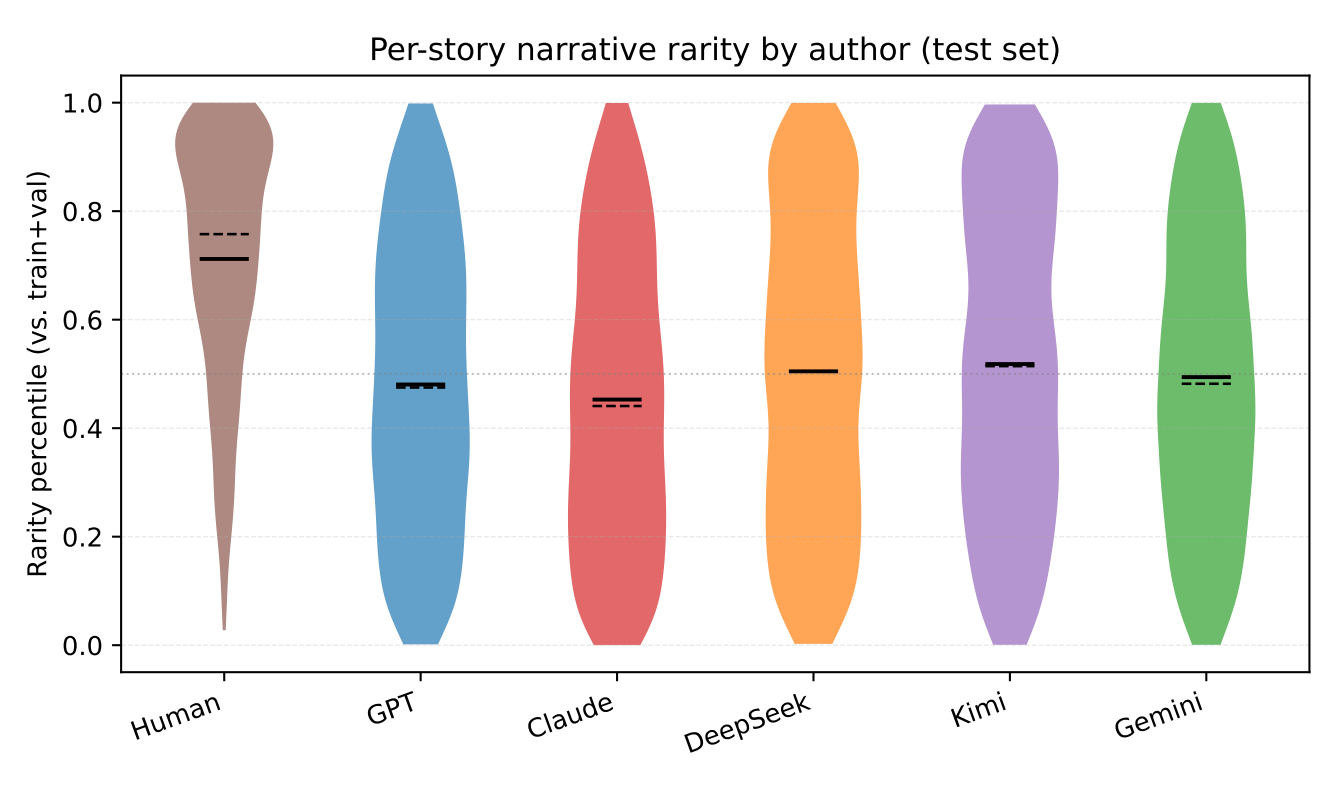
The differences? Human writers use more time jumps, flashbacks and flash-forwards, and nonlinear structure to delay key revelations.
Or: humans reference specific texts and authors at nearly double the AI rate, whereas AI generally sticks to vague allusions and avoids naming real brands, places, or works.
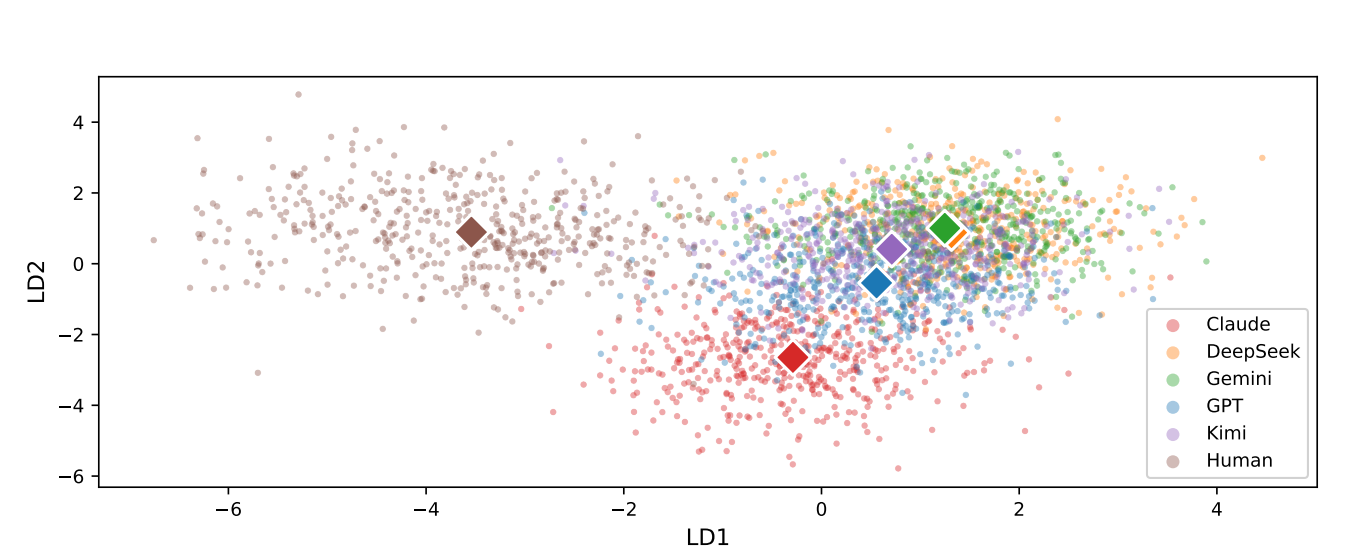
So the differences in underlying narrative construction, not just writing style, can be used to separate human-written original works from AI-generated fiction.
For now.
"I'm not sure whether, by building directories that name and shame these patterns, their authors are fighting AI slop or actually enabling it.
I lean towards the latter: thanks to research like this, the trope directories will be enhanced with much more complex traits (or more subtle, depending on how you look at it) in which a human differs from a large language model.
And every trait we name becomes one more thing the machine can learn to imitate.
The sermon
Anyway, I don't mean to write another "whiny sermon about how techbros have ruined it for self-anointed Tasteful People" (Venkatesh Rao).
You do you.
I just care about writing.
Not because it is good, but because it is important (ha ha).
Writing something by yourself helps you.
It gives you access to things you can't know just walking around or thinking. You learn things you didn't know, you capture ideas that you didn't expect.
Something exists more once you write it down.
In organic terms: the bandwidth of active memory & consciousness is rather narrow. Your memory, your thoughts and your reasoning are limited without aids. Short-term memory can hold about four to seven items at once.
Attention is a limited resource. Even just slightly more complicated thoughts cannot be arranged into a linear text/sequence in your head alone. You have to write them down (record them).
Also, the brain is a machine for jumping to conclusions = you need to balance out this trait (deficiency) = your mind needs scaffolding it can lean on. Somewhere it can delegate its reasoning to, somewhere it can spread itself out.
The fun
And of course, writing is one of the reasons I'm doing this whole Mirage Mir thing.
Not surrendering the fullness of the process to AI. Not generating content, but capturing notes, sketching drafts and constructing plots, characters, or arguments.
It is too much fun and too important to offload the effort (sic!) to a machine. Subbing out writing to AI = losing a way of thinking.
So don't let the machine take away the fun, create like nobody's watching.
The graphics
I promised myself to publish another chapter during the summer, but also to draw more pictures for the story.
Since the process must be fun and drawing feels more fun nowadays, I'm focusing on the visual part of the story. Hours spent drawing layers of a scene in Procreate.
Actually, it helps me write (discover, even?) the story.
Win-win.
Below, a sneak preview of a picture for the chapter in progress:
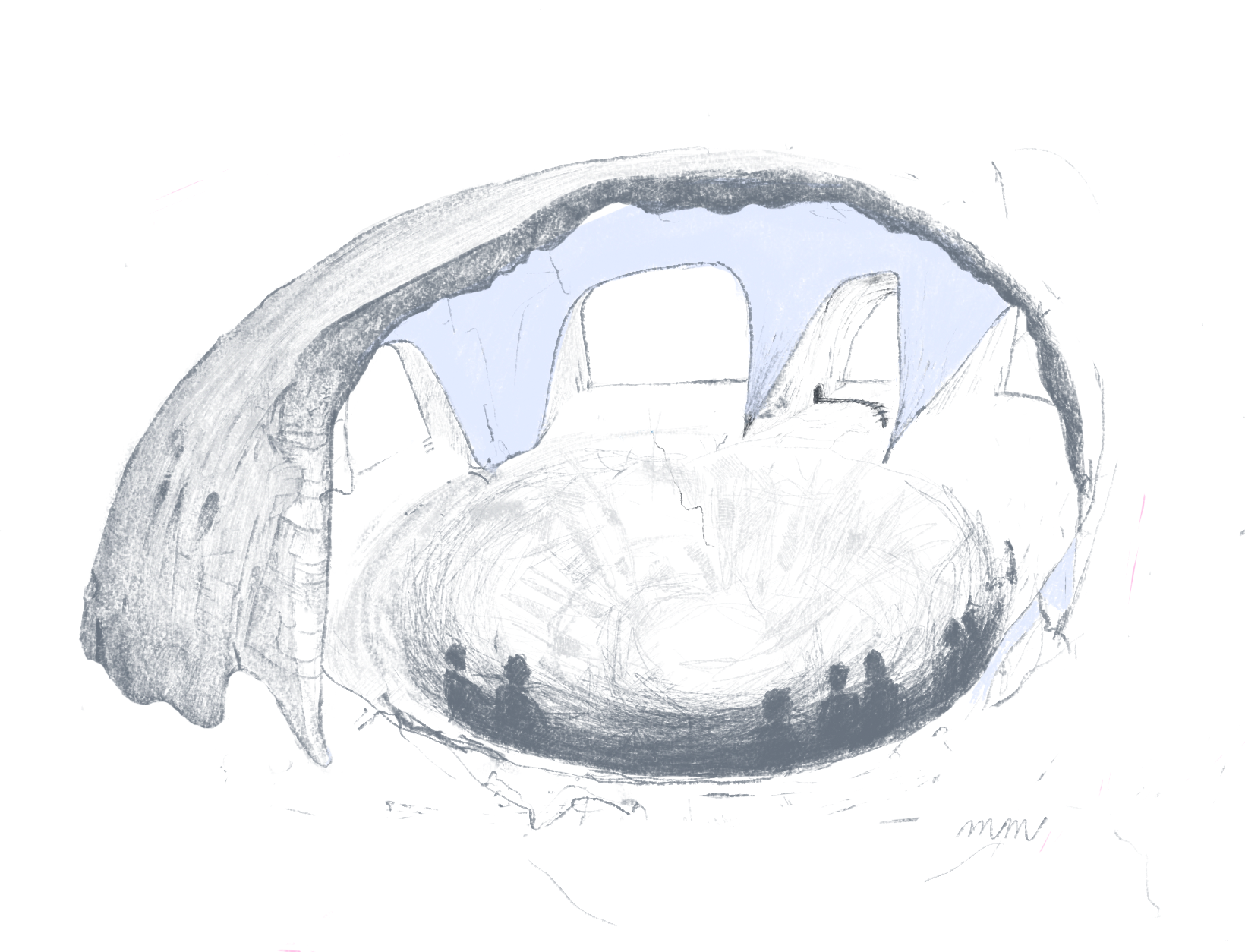
There are several areas in this image that can be explored in extreme close-up and used for illustrating different scenes/parts of the story, for instance:
- a dome or a vault arching over the depression: when you flip the image and zoom all the way in, there's a mountain range,
- train tracks emerging from one of the walls, but at the same time it looks like a scar, roughly stitched up (the tracks turning into a scar),
- or the flank of the bunker above the Installation of the Glass Bead Game playground, influenced by the visions of the seventies and eighties, of megastructures and space operas.
Cute bonus: the picture is drawn in layers and by switching them on and off, different mutations can be created, shifts or whole scene evolutions.
. . .
That's all folks. Stay tuned and thanks for reading.
Peter